Now to the end of P5
Strengthen P3–P6 topics. Use short mixed practice sets and keep an error log; preview P6 ideas gently.
Revision for Primary 6 pupils preparing for PSLE.
This guide is for PSLE Science revision. Revisit your P3–P6 concepts and practise explaining your thinking through 19 revision lessons, worked examples and practice answers.
Main checklist: Standard Science (0009). Foundation Science (0039) has a separate format and syllabus scope; see Exam format below.
18 topic lessons and one scientific inquiry lesson, covering every topic group in the Standard syllabus overview. Each has key ideas, a worked example and an answer you can reveal after trying. These are revision notes, not a replacement for your teacher’s full lessons.
The download saves a text file you can open in Notepad or any text editor. If no file appears, check your browser’s Downloads or choose Open all notes and answers. That page also includes every answer for printing.
Showing 19 of 19 lessons
Watch out: A moving car is not alive. It does not grow or reproduce as a living thing does.
A toy moves when switched on. A bean seed does not move across a table. Is the toy alive and the seed non-living?
Explanation: No. Movement alone is insufficient evidence. The seed is a living thing that can develop into a plant under suitable conditions. The toy cannot grow and reproduce.
An unfamiliar animal has feathers but cannot fly. Which animal group does it belong to? Explain.
Birds. Feathers are a characteristic of birds; the ability to fly is not required for an animal to be a bird.
Syllabus boundary: You are not required to recall names and unusual characteristics of particular species. Use the information in the question.
Mapped to MOE 2023 syllabus, printed page(s) 38. Check learning outcomes (PDF) · Original examples and suggested answers; not official exam questions.
Watch out: “Plastic is better” is incomplete. State which tested property makes it suitable for the stated purpose.
Material A absorbs water and bends easily. Material B does not absorb water and bends easily. Which is better for a raincoat?
Explanation: B. It is waterproof, so it does not absorb rainwater, and flexible, so it can bend as the wearer moves.
Two equal-sized strips support 4 and 9 identical weights before breaking. Which is stronger in this test?
The strip supporting 9 weights. It supports a greater load without breaking. Equal dimensions and identical weights make the comparison fairer.
Syllabus boundary: Density is not required. The labels transparent, translucent and opaque are not required; accurately describe how much light passes through.
Mapped to MOE 2023 syllabus, printed page(s) 39–40. Check learning outcomes (PDF) · Original examples and suggested answers; not official exam questions.
Watch out: Not all insects have a pupa. Do not insert a pupal stage into a grasshopper’s life cycle.
Cycle A is egg → larva → pupa → adult. Cycle B is egg → nymph → adult. Give one difference.
Explanation: Cycle A includes a pupal stage, while cycle B does not. The larva in A also differs more in appearance from its adult than the nymph in B does.
Why can removing stagnant water help reduce mosquitoes?
It removes places where mosquitoes can lay eggs and where their larvae and pupae develop, interrupting their life cycle.
Syllabus boundary: The syllabus names chicken, cockroach, frog, grasshopper, beetle, butterfly and mosquito for life-cycle comparisons.
Mapped to MOE 2023 syllabus, printed page(s) 42. Check learning outcomes (PDF) · Original examples and suggested answers; not official exam questions.
Watch out: Pollination and fertilisation are different processes. Also, do not say that all ideas about cells have been removed: basic cells and reproductive cells remain in scope.
A fruit has hooks that attach to an animal’s fur. How can this help the young plant survive?
Explanation: The animal carries the fruit away before it drops. Seeds can grow farther from the parent, reducing competition with it for light, water and space.
Two groups of viable seeds are kept equally warm with access to air. Only one receives water. Why does the dry group fail to germinate?
Water is required for germination. Keeping warmth and air the same helps show that the lack of water caused the difference.
Syllabus boundary: Stem cutting, pollen-tube formation, the labels self-/cross-pollination, the specific location of human fertilisation, and details of foetal development/umbilical-cord mechanisms are not required.
Mapped to MOE 2023 syllabus, printed page(s) 43–45. Check learning outcomes (PDF) · Original examples and suggested answers; not official exam questions.
Watch out: Pouring water into a differently shaped container changes its shape, not its volume, provided none is lost.
A stone is fully submerged. The water reading rises from 40 ml to 55 ml. What is the stone’s volume?
Explanation: 55 − 40 = 15 ml, equivalent to 15 cubic centimetres. The stone displaces water equal to its own volume.
Why is a syringe of trapped air easier to compress than a syringe filled with water, when both outlets are sealed?
Air, a gas, can occupy a smaller volume when compressed. Liquid water has a nearly fixed volume and is difficult to compress.
Syllabus boundary: Focus on observable properties and measurement; a particle model is not needed for this topic’s listed outcomes.
Mapped to MOE 2023 syllabus, printed page(s) 48. Check learning outcomes (PDF) · Original examples and suggested answers; not official exam questions.
Watch out: Droplets outside a cold cup come from water vapour in the surrounding air, not water leaking through the cup.
Why do equal amounts of water dry faster in a wide dish than in a narrow cup under the same conditions?
Explanation: The wide dish exposes a larger water surface area to the air, increasing the rate of evaporation. More water changes to water vapour in the same time.
A cool lid is held above hot water. Why do droplets form on its underside?
Water vapour from the hot water loses heat at the cooler lid and condenses into liquid water droplets.
Syllabus boundary: Explain the process and heat transfer, not merely the name of the state change.
Mapped to MOE 2023 syllabus, printed page(s) 49–50. Check learning outcomes (PDF) · Original examples and suggested answers; not official exam questions.
Watch out: Fertiliser is not food made by the plant. Green plants make their own food.
A plant has badly damaged roots. Explain why its leaves may wilt even when there is water in the soil.
Explanation: The damaged roots may absorb less water. Less water reaches the leaves, so they can wilt.
How does a stem help leaves make food?
It supports and positions leaves to receive light, and provides a route for water to reach them.
Syllabus boundary: Detailed transport tubes are introduced in P5; learn the basic functions first.
Mapped to MOE 2023 syllabus, printed page(s) 56. Check learning outcomes (PDF) · Original examples and suggested answers; not official exam questions.
Watch out: Do not infer that water-carrying tubes also carry food simply because both are inside the stem.
A leafy stem stands in coloured water. Later, coloured lines appear in the stem and leaf veins. What does this show?
Explanation: The coloured water travelled through water-carrying tubes in the stem to the leaves. The colour provides evidence of the water’s path.
A diagram states that only food-carrying tubes are cut between the leaves and roots. What happens to food supply to the roots?
Less or no newly made food can pass through the cut tubes to the roots. Use the stated damage; do not assume water-carrying tubes were also cut.
Syllabus boundary: Recall of relative tube positions, the names xylem/phloem, and transpiration pull are not required.
Mapped to MOE 2023 syllabus, printed page(s) 57. Check learning outcomes (PDF) · Original examples and suggested answers; not official exam questions.
Watch out: Digested food is mainly absorbed in the small intestine, not in the stomach.
Why must food be digested before most of it can be used by the body?
Explanation: Digestion breaks food into simpler substances that can be absorbed into the blood and transported to the parts that need them.
Which part absorbs digested food, and which system carries it around the body?
The small intestine absorbs digested food into the blood. The circulatory system transports it.
Syllabus boundary: Detailed bone and muscle names and mechanisms are not required.
Mapped to MOE 2023 syllabus, printed page(s) 53. Check learning outcomes (PDF) · Original examples and suggested answers; not official exam questions.
Watch out: The heart pumps blood, not air. The lungs do not pump blood around the body.
Why does a runner’s heart beat faster than when resting?
Explanation: The working body parts need more energy. Faster pumping carries oxygen and digested food to them more quickly and carries carbon dioxide away more quickly.
Explain how oxygen reaches a leg muscle after being breathed in.
Air reaches the lungs through the respiratory system. Oxygen passes into the blood, and blood pumped by the heart carries it through blood vessels to the leg muscle.
Syllabus boundary: Alveoli, heart chambers/valves and the specific terms artery, vein, capillary and stomata are not required.
Mapped to MOE 2023 syllabus, printed page(s) 54. Check learning outcomes (PDF) · Original examples and suggested answers; not official exam questions.
Watch out: A circuit may look like a loop but still fail if a connection is on an insulating part or bypasses the bulb.
Two bulbs are on separate parallel branches. A switch opens only the first branch. What happens?
Explanation: The first bulb goes out because its path is broken. The second can remain lit because its own complete path through the battery remains.
A plastic strip placed in a gap prevents a test bulb lighting. A metal strip makes it light. What can you conclude?
In this test, the metal strip conducts electricity and completes the circuit; the plastic strip is an electrical insulator. The other circuit components must be working for this comparison.
Syllabus boundary: Standard Science includes bulbs in series and parallel; do not assume the same depth for Foundation Science.
Mapped to MOE 2023 syllabus, printed page(s) 59. Check learning outcomes (PDF) · Original examples and suggested answers; not official exam questions.
Watch out: Attraction does not prove that both objects are magnets; one may simply be a magnetic material.
End X repels the north pole of a known magnet. What is X?
Explanation: X is a north pole of a magnet because like poles repel. A piece of unmagnetised iron would be attracted rather than repelled.
A steel paper clip is attracted to both poles of a magnet. Must the paper clip itself be a magnet?
No. Steel is a magnetic material and can be attracted by either pole without the clip already being a magnet.
Syllabus boundary: Magnetic shielding, magnetic induction, and recall of nickel/cobalt as magnetic materials are not required.
Mapped to MOE 2023 syllabus, printed page(s) 62. Check learning outcomes (PDF) · Original examples and suggested answers; not official exam questions.
Watch out: A book resting on a table still experiences gravity. Being stationary does not mean no forces act.
A spring is 8 cm long without a load and 11 cm with a load. What is its extension?
Explanation: 11 − 8 = 3 cm. The load stretches it, and the spring exerts a restoring force.
Identical blocks slide from the same starting speed across two surfaces. One stops sooner. What is a possible explanation?
The surface where the block stops sooner may exert a greater frictional force, slowing it more quickly. Keep block and starting conditions the same when testing this explanation.
Syllabus boundary: The direction of friction for rolling objects and the specific labels air resistance/water resistance are not required.
Mapped to MOE 2023 syllabus, printed page(s) 63–64. Check learning outcomes (PDF) · Original examples and suggested answers; not official exam questions.
Watch out: In grass → grasshopper → frog, the arrow does not point towards what the frog eats; it follows the direction of food energy transfer.
In grass → grasshopper → frog, frog numbers fall. Predict one possible effect on grass.
Explanation: With fewer frogs eating grasshoppers, grasshopper numbers may rise. More grasshoppers may eat more grass, so grass may decrease, assuming other conditions remain similar.
A seed has a broad wing. Explain how this feature can improve the offspring’s chance of survival.
The wing helps wind carry the seed away from the parent. The young plant may then face less competition with the parent for light, water and space.
Syllabus boundary: Standard Science includes food webs, population/community distinctions and structural and behavioural adaptations.
Mapped to MOE 2023 syllabus, printed page(s) 67–70. Check learning outcomes (PDF) · Original examples and suggested answers; not official exam questions.
Watch out: The Moon reflects sunlight; it does not produce its own visible light like the Sun.
Why can you not see a book in a room with no light at all?
Explanation: No light reflects from the book into your eyes. The book is not itself a light source.
A lamp and screen stay fixed. An object moves closer to the lamp. What usually happens to its shadow size?
The shadow becomes larger because the object blocks a wider region of the light reaching the screen. This assumes a small light source and the stated arrangement.
Syllabus boundary: The law of reflection and the specific terms transparent/translucent/opaque are not required.
Mapped to MOE 2023 syllabus, printed page(s) 75. Check learning outcomes (PDF) · Original examples and suggested answers; not official exam questions.
Watch out: “Cold flows into the drink” is incorrect. A colder drink gains heat from warmer surroundings.
Why does wrapping ice in a thick insulating layer slow its melting?
Explanation: The layer reduces the rate of heat transfer from the warmer surroundings to the ice. The ice gains heat more slowly and melts more slowly.
A metal lid is warmed and becomes easier to loosen. Suggest why.
The lid gains heat and expands, increasing its size so it can fit less tightly. The explanation depends on the lid being warmed more effectively than the container neck.
Syllabus boundary: You need not memorise the relative heat-transfer rates of particular metals.
Mapped to MOE 2023 syllabus, printed page(s) 76–77. Check learning outcomes (PDF) · Original examples and suggested answers; not official exam questions.
Watch out: Plants do not obtain their food from soil. Water and mineral salts absorbed by roots are not the sugar made during photosynthesis.
A green water plant produces more oxygen bubbles in brighter light in a controlled test. What might explain this?
Explanation: The greater light availability can increase photosynthesis, producing oxygen faster. The comparison assumes water, carbon dioxide, plant size, temperature and observation time are suitably controlled.
Does a plant respire in the dark? Can it photosynthesise then?
It still respires, releasing energy from food. It cannot photosynthesise without light.
Syllabus boundary: The focus of respiration is release of energy from food; detailed biochemical processes are not required.
Mapped to MOE 2023 syllabus, printed page(s) 78. Check learning outcomes (PDF) · Original examples and suggested answers; not official exam questions.
Watch out: A stationary raised object can have potential energy even though it has no kinetic energy from motion.
A stretched spring launches a toy car. Describe the main energy change.
Explanation: Potential energy stored in the stretched spring is converted mainly to kinetic energy of the moving car, with some energy transferred as sound and heat.
Give an energy pathway for sunlight powering a solar-panel fan.
Light energy from the Sun → electrical energy from the solar panel → kinetic energy of the fan blades, with some sound and heat also produced.
Syllabus boundary: The specific labels chemical, gravitational and elastic potential energy are not required. Identify where the potential energy is stored.
Mapped to MOE 2023 syllabus, printed page(s) 80. Check learning outcomes (PDF) · Original examples and suggested answers; not official exam questions.
Watch out: Do not claim a fair test when both the intended factor and another relevant condition changed.
A pupil compares drying in wind using 20 ml in a wide dish beside a fan and 40 ml in a narrow cup elsewhere. How should the test improve?
Explanation: Use identical containers with the same starting water volume, temperature and observation period, changing the airflow only. Otherwise volume and exposed surface area could explain a difference as well as wind.
A spring measures 8 cm with no load, 10 cm with one weight and 12 cm with two identical weights. State a supported trend and one limit.
In the tested range, each added weight increases length by 2 cm. These results do not prove that the spring will keep extending by 2 cm for every additional weight at any load.
Syllabus boundary: These skills apply across all themes. The example answers are original learning aids, not official mark schemes.
Mapped to MOE 2023 syllabus, printed page(s) 16–19, 33–35. Check learning outcomes (PDF) · Original examples and suggested answers; not official exam questions.
See the connections
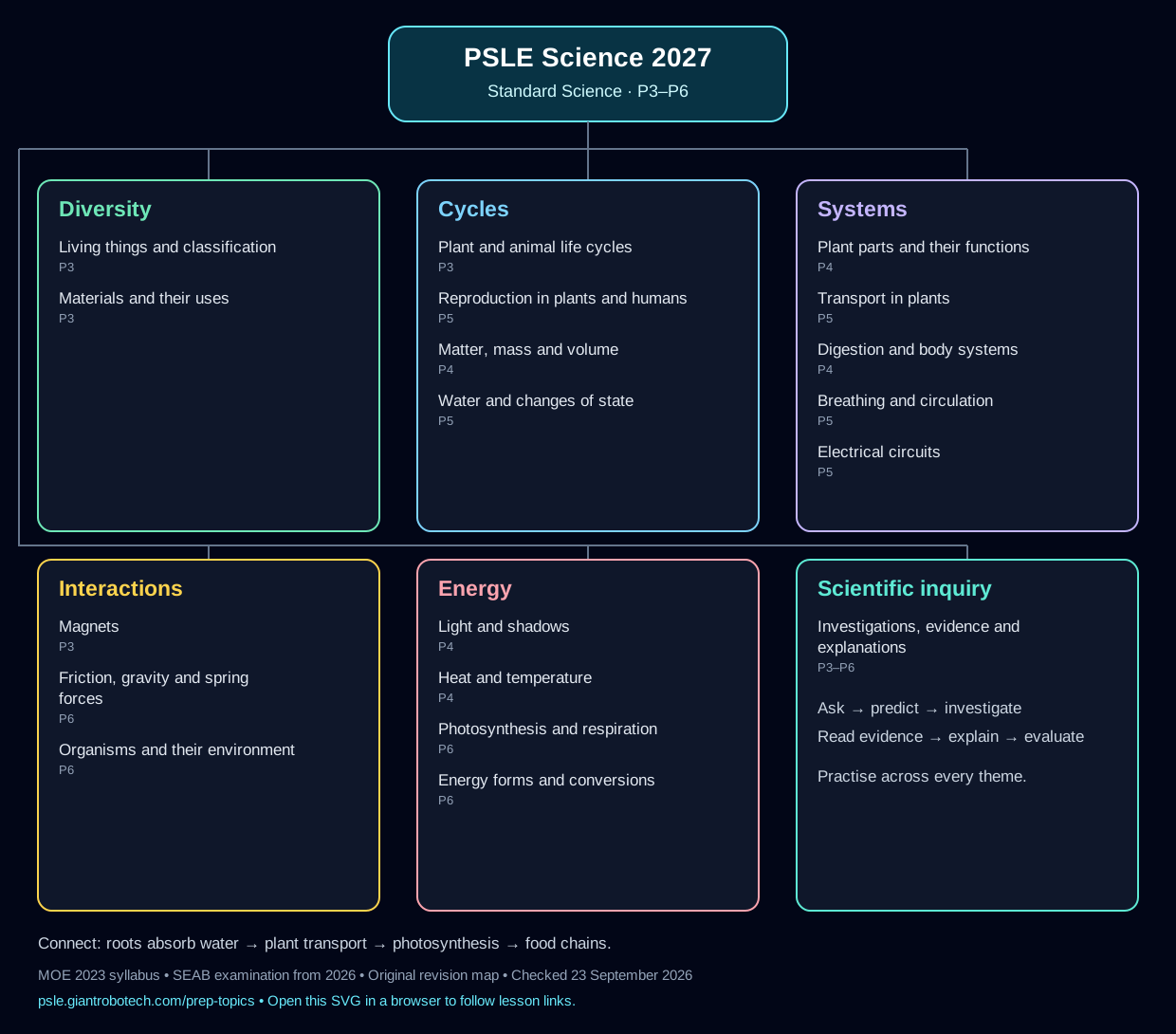
Follow a branch to open its lesson. The five themes connect through scientific inquiry: ask, investigate, use evidence and explain.
PSLE Science 2027
Standard • P3–P6 learning
Try a connected explanation: roots absorb water → tubes carry water to leaves → photosynthesis makes food → food supports a food chain. Use the related-lesson links to explore more connections.
SEAB specifies the 2023 primary science syllabus for examinations from 2026. Standard Science is one written paper lasting 1 hour 45 minutes. Answer all questions in both booklets.
BOOKLET A
30 multiple-choice questions, each worth 2 marks. Four options per question.
BOOKLET B
10–11 structured questions, each worth 2–5 marks.
Cover earlier primary learning as well as P6 topics. This is a topic overview, not a replacement for the detailed learning outcomes in your school materials. Open each card for an original practice prompt.
Try this: Compare two materials for a raincoat. Which property makes one more suitable, and why?
Try this: Water droplets appear outside a cold cup. Explain where the water comes from and how it forms.
Try this: Trace how water reaches a leaf. For circuits, check whether there is a complete conducting path.
Try this: Explain a shadow using the path of light. Trace the energy changes when a battery powers a lamp.
Try this: Use a food web to explain how a change in one population could affect another.
Make a prediction, interpret results, evaluate a method and explain your reasoning. Work with diagrams, tables and graphs as well as written questions.
Topic overview cross-checked against MOE’s 2023 Primary Science syllabus (PDF). Inquiry requirements: SEAB specification effective from 2026.
No fixed topic percentages: SEAB’s published format gives marks by booklet, not by theme. Choose extra practice from your mistakes rather than an assumed “high-weightage” ranking.
The suggestions below are learning techniques, not an official marking formula.
Question: A dry cup containing ice water is left in a warm room. Why do droplets form on its outside?
Explanation: Water vapour in the surrounding air loses heat when it touches the cold outer surface of the cup. It condenses into liquid water droplets.
Notice the chain: source of water → loss of heat → condensation → observed droplets. Saying only “the cup is cold” does not explain the change of state. Original example; not an official PSLE question or marking scheme.
Timing practice: As a starting point for a Standard paper, try 40 minutes for A, 55 for B and 10 to check. This is a suggested split, not an official time limit for each booklet. Adjust it after a practice attempt.
Strengthen P3–P6 topics. Use short mixed practice sets and keep an error log; preview P6 ideas gently.
Revise each topic after it is taught. Revisit earlier themes each week and practise interpreting evidence and explaining cause and effect.
Use suitable timed papers, review every mistake and practise weaker concepts again. Follow your school’s schedule rather than an unconfirmed examination date.
Suggested study plan, not an official MOE or SEAB timetable.
Adapt this suggested plan to your school timetable and remaining time. Use short, focused sessions with breaks. If you have longer, spread each stage out and revisit mistakes between sessions.
DAY 1
Review a recent marked paper. Sort mistakes into concept, evidence, explanation and careless reading. Pick three gaps to repair.
DAY 2–3
Review Diversity and Cycles, including materials, matter and reproduction. Do a small mixed set of MCQs and structured questions.
DAY 4–5
Revise human and plant systems, circuits, light and heat. Draw simple diagrams from memory, then check them against your notes.
DAY 6–7
Practise photosynthesis, energy conversions, forces and environmental interactions. Add one table, graph or fair-test question each day.
DAY 8
Use a paper suitable for your course. Standard Science: 105 minutes. Mark it carefully and identify the cause of each mistake.
DAY 9
Rewrite incomplete explanations and attempt similar questions without looking at the answer. Ask your teacher about anything still unclear.
DAY 10
Review your error log and key diagrams. Pack according to your school’s instructions and allow time for rest.
Keep a useful error log: Write the concept, what misled you, a corrected explanation and a date to retry. Understanding one recurring mistake is more useful than rushing through another paper without review.
Prepare using the MOE 2023 primary science syllabus for your course. SEAB’s published Science specifications apply from 2026. As checked on 23 September 2026, its PSLE page still lists 2026 formats; no separate 2027 notice was located. Recheck SEAB and your school for any later amendments.
The published Science specification effective from 2026 does not assign fixed percentages to individual topics. Revise all five themes and use your own marked work to decide where you need more practice. Topic predictions cannot guarantee marks.
Prepare for both booklets. Standard Science allocates 40 marks to structured questions. Practise short, accurate explanations alongside MCQs, even when you are rebuilding your basics.
Yes, as additional concept practice after checking topic relevance with your teacher. Use the published specification effective from 2026, and check for any later SEAB amendments, for current question counts and timing; older papers and this site’s existing practice sets may differ.
No. This is an independent revision guide. Official sources are linked below. The practice prompts, answer example and revision plan are our study suggestions, not official questions or a marking scheme.
Checked on 23 September 2026. This guide covers Science only. Refer to SEAB for the other PSLE subjects and to your school for course-specific instructions.
Choose a revision lesson, try its practice question and explain your answer before revealing the suggested response.
Explore revision lessons